
37: Turn. The volume. Up!
Breaking the stranglehold of the screen, getting real and Grandma

I’ve never actual-LOL’d at a campaign speech before. Zohran nails it from 16m50s.
In more fabulous news, Matt Adams of Blast Theory (a studio that has blasted boundaries in art and technology for decades) is now cancer free after a stem cell transfusion from his brother. Weirdly, he now has hairier legs.
Read on for links n notes from culture, technology, sustainability and play.
Is this the tech we asked for?
Mostly automation; some VR.
Waymo is coming to London. Good luck navigating Soho at midnight, mate.
Learn your way is a Google product ostensibly for classrooms that turns “content” (PDFs of dusty old text books) into “educational formats” (interactive slides and mind maps!)
EXP in Rosemont, near Chicago, is now open, “where the next generation of storytelling comes alive in the largest immersive venue in the US Midwest.” Social VR, physical spaces, historical worlds, you get the gist. Trailers here.
Monetization.wtf is handy. Check whether your social media diet is being PAID FOR by nasties. The tool is from What to Fix, which is one of those outfits that gives some reassurance everything will be ok.
Cultural subversion
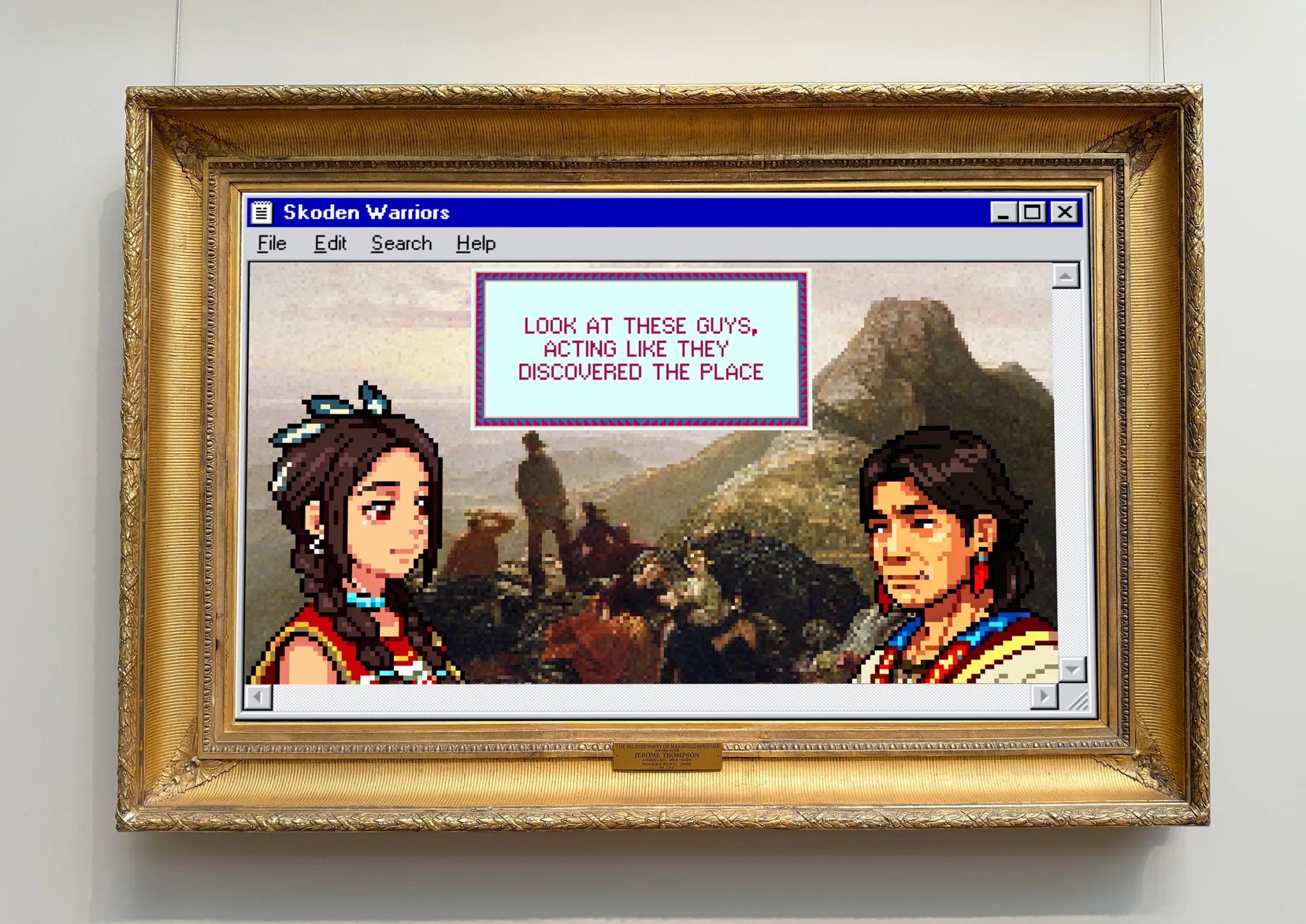
Indigenous artists in the US created an “unsanctioned” takeover of selected Met artworks. This is exactly the sort of AR+art combo I’m here for.
Meanwhile, in Germany, a “grumpy art tour” is all the rage. Guests are queuing up to be spoken down to. The performer seems to be enjoying himself.
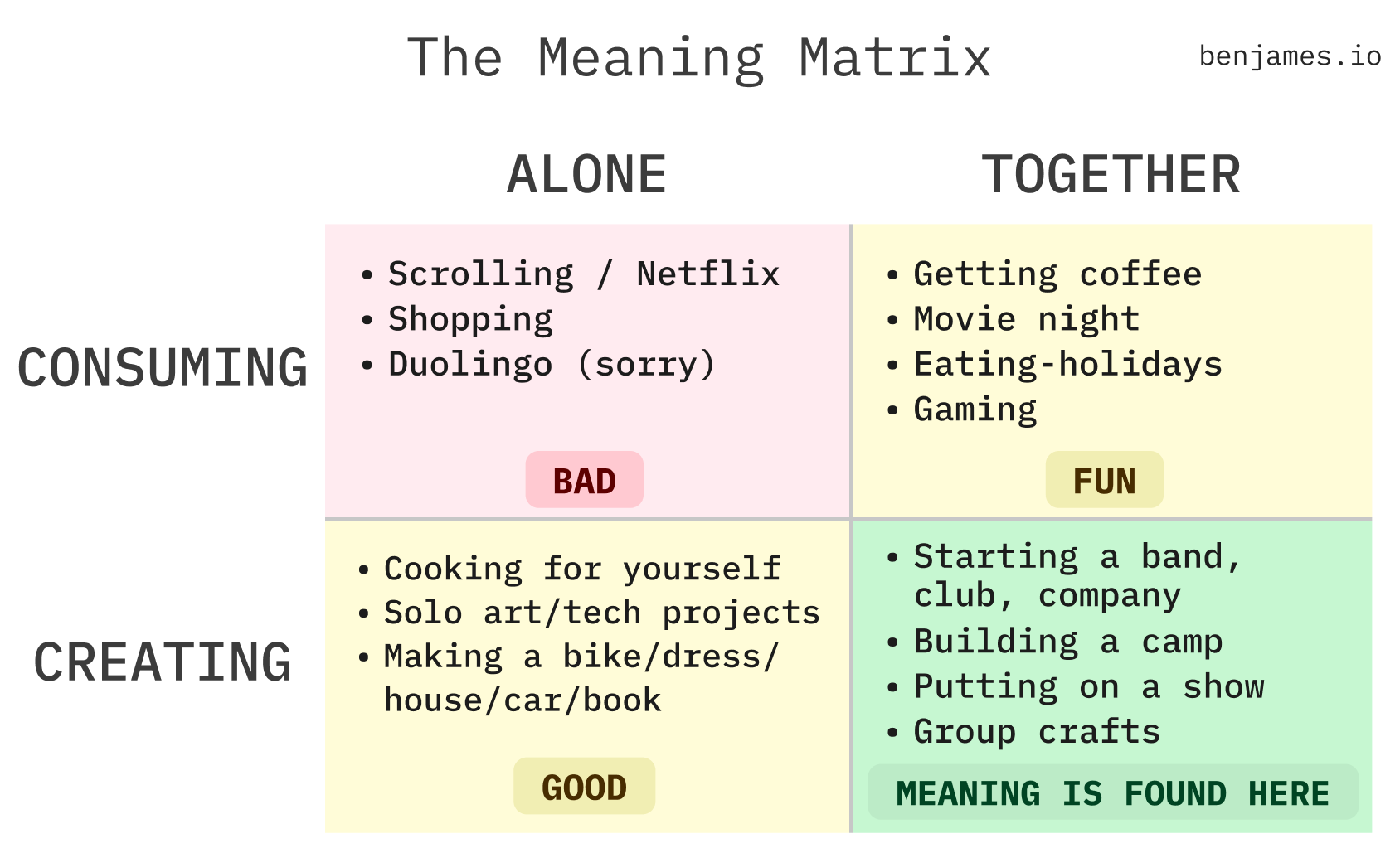
Which neatly leads us to our trend of the year! The “return to real”, as evidenced in the growth of dumbphones / digital detoxes / book clubs / sauna clubs / park runs / a chap getting 1,000 people to watch him fold a fitted sheet etc. Apparently Gen Z-ers are “chaining their mobiles to the wall,” harking back to the good old landline. This swanky 73 page deck gives more background to the “trend”. Ben James made an “aliveness” matrix that everybody loved. It maps a consume-create axis against alone-together. He says:
“In many ways, the thin-ness of life in 2025 can be explained by our drift away from quadrant four.”
The alternative for many young men is a descent into the “manosphere”. Let’s briefly step in, courtesy of The Guardian’s very well produced scroll-story. It combines infographics, statistics, anonymous video testimony, Andrew Tate clips and editorial. Digest the core elements - loneliness, masculinity, purpose, wealth - and how influencers leverage them, without having to spend 14 hours on TikTok.
Is it play time yet?
Board - a very cool-looking physical-digital social game. As you’d expect, Alex Fleetwood was tangentially involved. I’m paying attention.
Hidden Door - AI generated play from a studio “that can adapt any existing work of fiction into an online social roleplaying game.” Bit like Playbrary.ai
Chartle - guess the country from the line on the chart. Political play, without meaning to be. Found via Web Curios.
Three Lessons from Stranger Folk
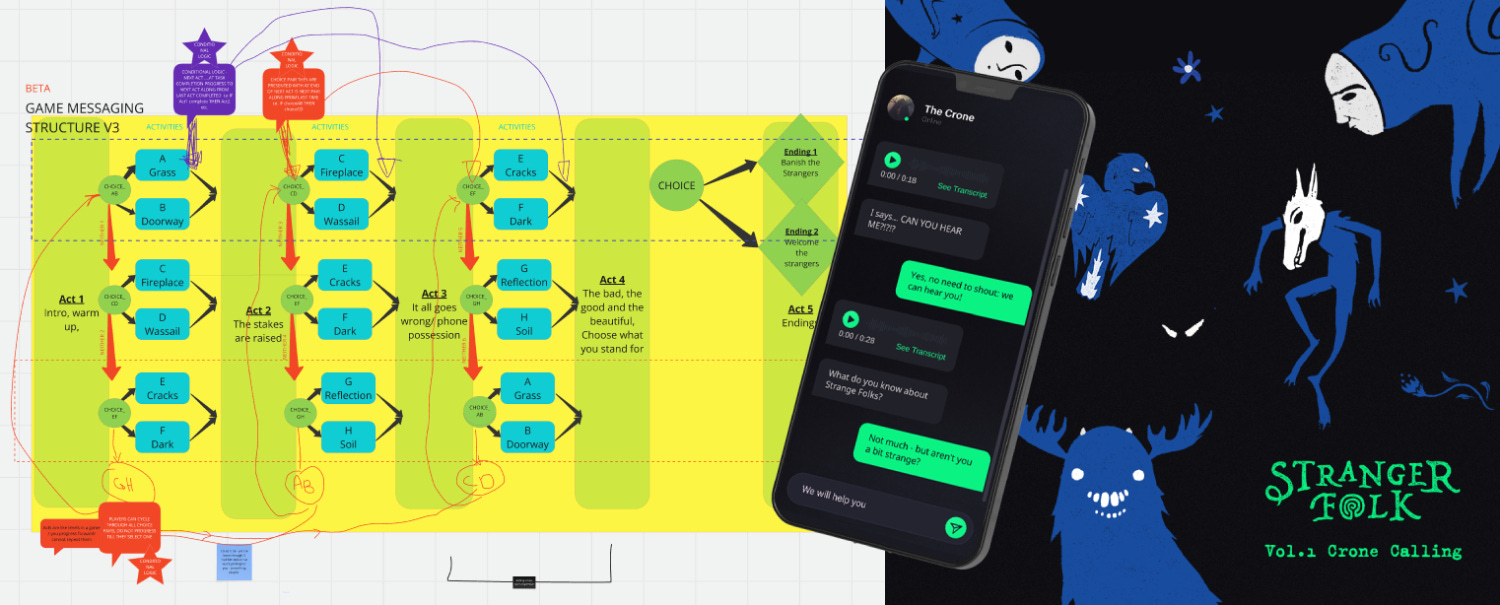
It’s a mobile game (with boggarts and fae folk) but the idea is you engage with nature and each other, not the screen.
Here are three quick lessons from production:
Maintain the heads-up vibe. Many have tried: Forestry England has Gruffalo Spotter (£unknown). HRP created Time Explorers (£200k+). British Museum launched then canned Adventure Cards (~£100k). Aardman made Wetland Heroes (~£80k). Science Museum still has the AR-ey Wonderlab (~£100k) V&A has the web-app Secret Seekers (£70k). I worked on four of these and each time we struggled to break the stranglehold of the screen. There is no single lesson but a few principles, perhaps:
Lean into audio. People can look up when they’re listening.
Familiar UX conventions, i.e. Stranger Folks is built around a chat interface to quickly set expectations.
Stepped interaction, i.e. a choice-consequence loop, rather than the continuous interaction a racing game might require.
Clear transitions from screen to real-world, i.e. the phone stops doing things whilst the humans do things.
Constrain your narrative branches. Meaningful choice is rewarding but it’s also expensive. We knew from testing that players wanted to try again for new endings, so “number of endings” was an important point of scope. Another trick is using cosmetic choice to build rapport and pad things out a little. Writer Rosie worked hard to create a deceptively simple branching system and even that was tricky to write for. Far easier to start small and add detail later than hack bits off an unwieldy monster.
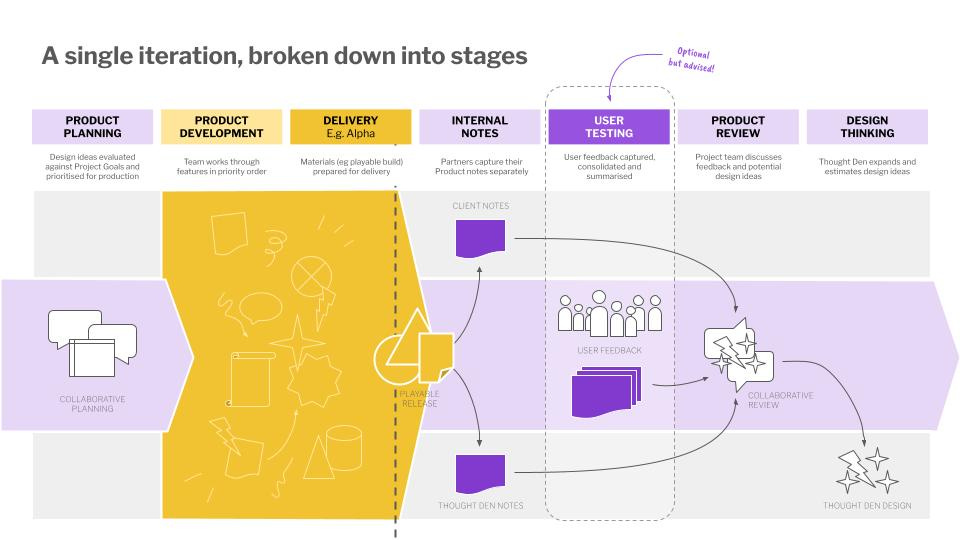
Build a rhythm of collaboration. My team grumbled about “all the meetings” but also enjoyed the smooth production, so…it paid off? Each production cycle had the same beats:
A big kick-off, to define and prioritise
Short weekly check-ins to course-correct.
A big sprint review, to filter user testing data and generate ideas.
And repeat! This is my diagram. Everyone likes it. No-one understands it.
Grandma didn’t blog about it
I enjoyed listening to Christabel Reed on the Inspire Action podcast. She has excellent schtick: making nature restoration mainstream; improving access, not raising awareness; turning online learning into offline action; building mass-mobilised, peer-driven, well-resourced and resilient communities.
Her charity Earthed.co offers short courses “run by the world’s greatest nature leaders”.
She had a nice phrase about storytelling that I’ll mangle: people think we’re entering a post-story, post-truth world, but the myth of a growth-based economy on a finite planet remains the biggest story of all.
So we need new stories, basically.
Look at this beautiful film, Future Council - eight kids on a road trip across Europe to challenge powerful leaders.
And here’s Adam sharing his two pennies with Critical Action Lab Fellows:
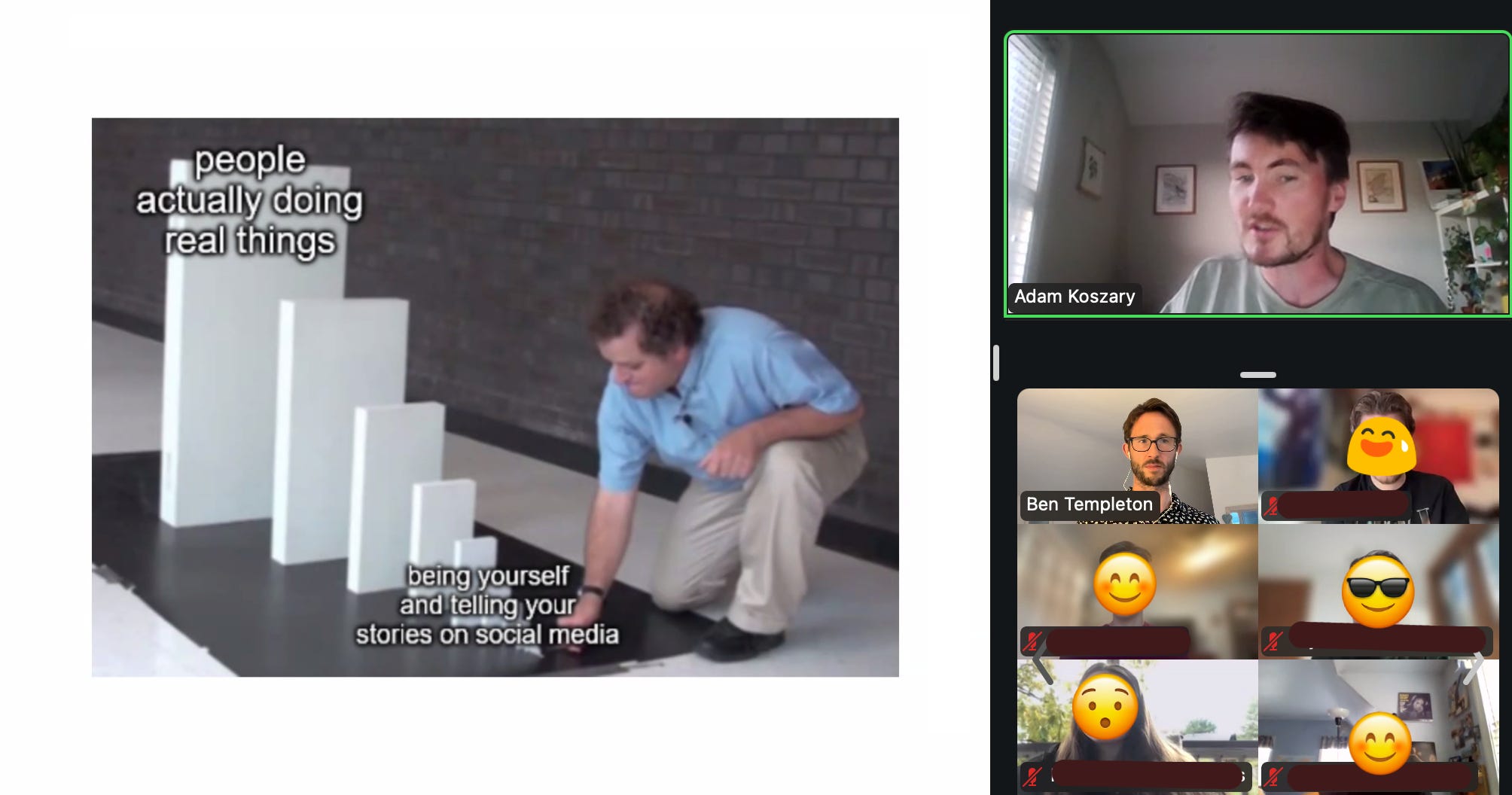
All of which somehow brought me to Grandma, a woman whose approach to life I wish I followed more closely.
She grew her own vegetables. Volunteered at Oxfam and brought home obscure boardgames. She donated to the Red Cross and darned socks. She tore through books, in French and English. Cooked healthy meals from scratch every day, with a crafty twinkle in her eye for the occasional oven pizza lapse. She sold Fair Trade products from a cupboard in the barn and gave us goats for Christmas.
None of which she blogged about! No Insta Reels guaranteeing epic tomato yields. No humble-brag on LinkedIn about completing the new till training.
She just cracked on.
So I’m reflecting on two things that sometimes come into opposition: doing the work and talking about the work.
Stories are powerful and we need them to inspire more people to start building a world we’re all able to live in.
But also: be more Grandma. Don’t just post about it, get on with it, one step at a time.
Aaaand, that’s it!
How much are you trying to cram into the remaining weeks before Xmas hits you in the baubles? Good luck! Enjoy the mulled wine, I’ll be back soon.
B.
PS - no PS this week, soz.